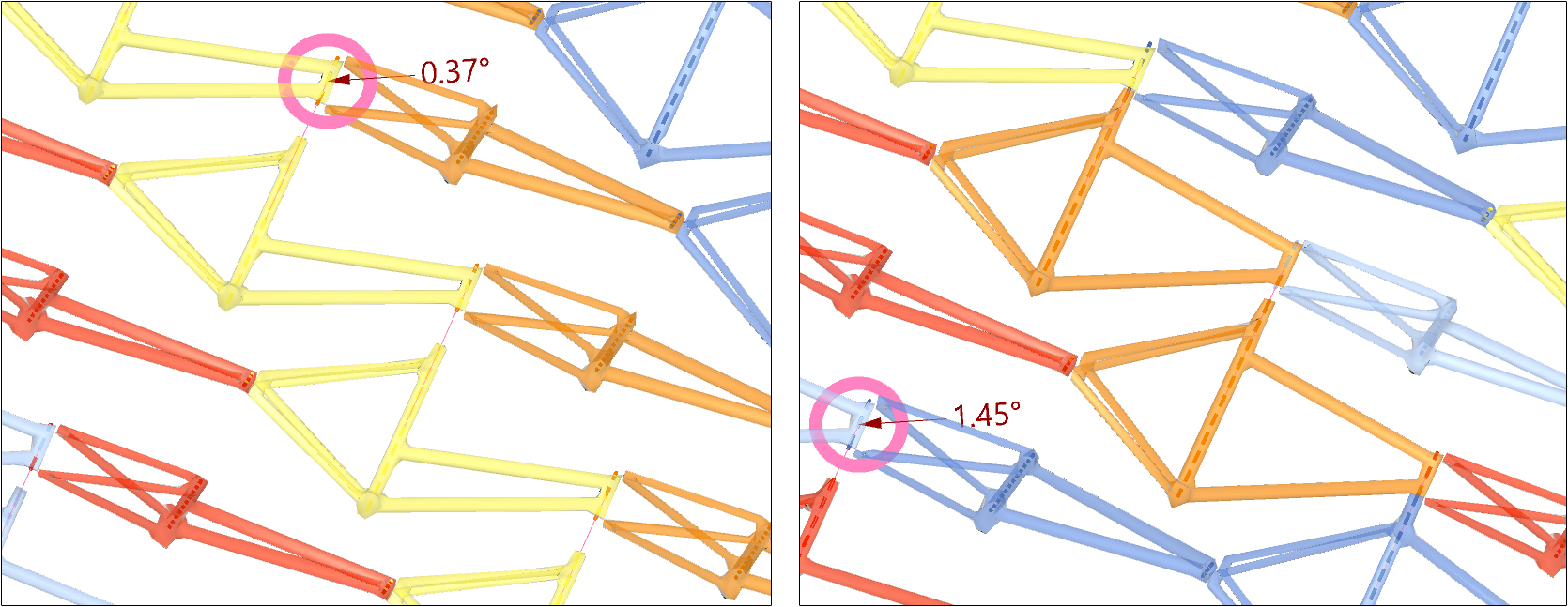
A new type of pattern for aggregating bicycle frames allows for more adaptability.
Continue reading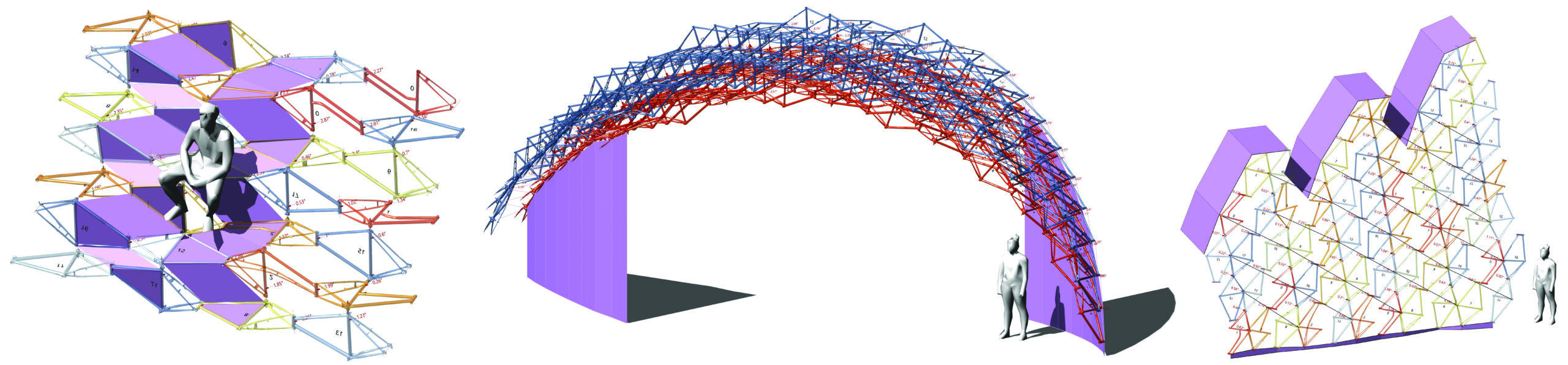
Based on the specific potentials, we sketched potential use case scenarios for three different patterns.
Continue reading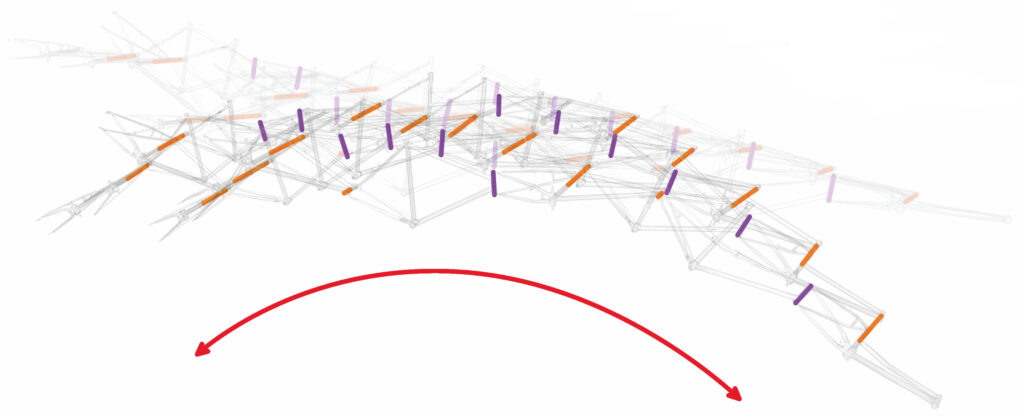
Besides varying capabilities for adapting to form variation of constituent parts, the surface-based bike-frame aggregations we studied previously, also have different bending flexibility.
Continue reading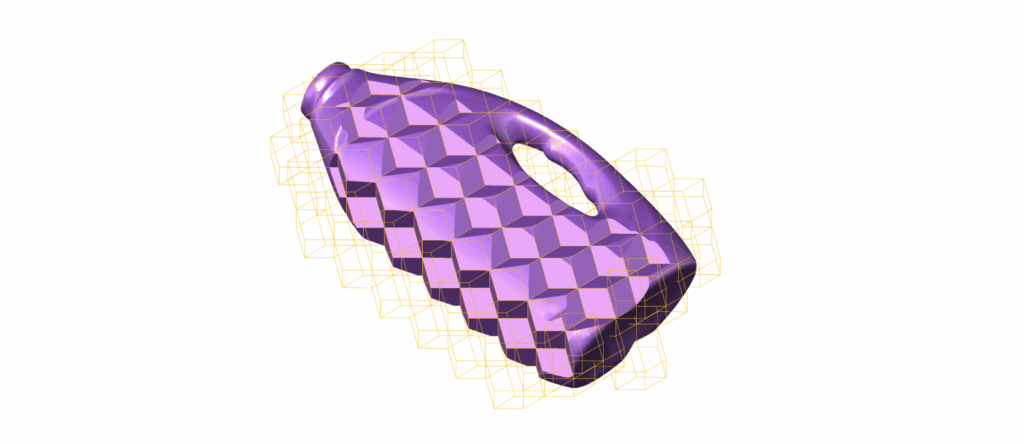
In this part of our ongoing exploration into how detergent bottles can become building blocks, we return to the idea of designing the shape of the bottle. Not by changing the form in complex ways, but by applying what we’ve learned from space-filling geometry.
Instead of completely transforming the bottle, we focused on minimal modifications, while making it suitable for a second life as a modular element.
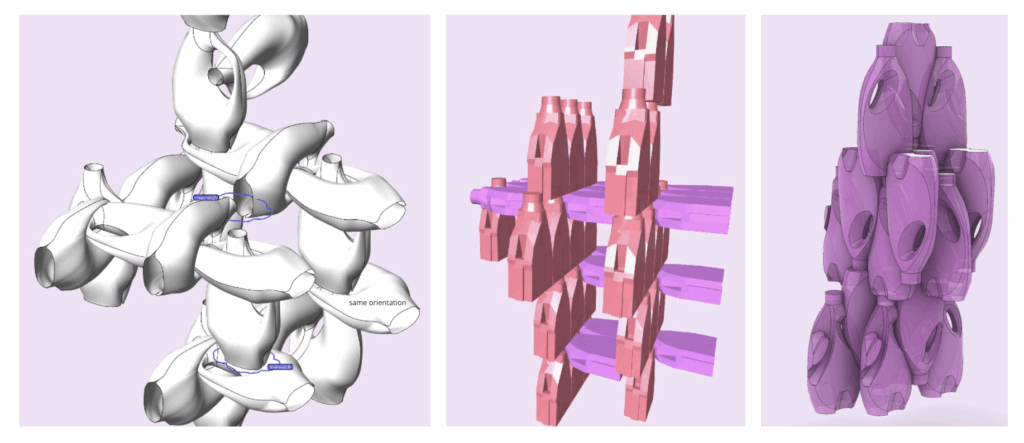
Learning from the WOBO bottle – (you can read more in our previous blog post) – we were fascinated by how the design embedded reuse directly into the form of the packaging.
We’ve been exploring the idea of giving packaging not just a second life through recycling, but a second function through design. This led us to experiment with how detergent bottles could be transformed into interlocking, modular components, inspired by Japanese joinery, 3D puzzle logic.
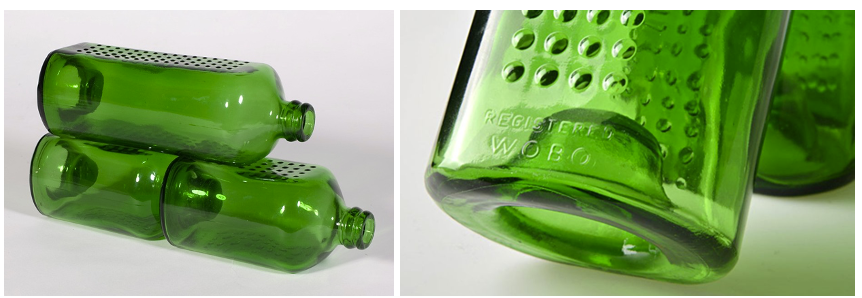
WOBO: The Beer Bottle Designed to Build Homes. In the 1960s, Alfred Heineken visited Curaçao and noticed two things: beaches were littered with glass bottles, many from his own brand, and a huge housing shortage. This led him to an idea: what if beer bottles could be used as bricks for housing?
Continue reading
In this phase of the project, we’ve shifted our perspective. Until now, the physical experiments revolved around pressing artefacts into a predefined geometric mold. Specifically, we worked with the Peter Pearce’s Curved Space System, using saddle pentagons to form a continuous surface. This approach treated geometry as the fixed system, and artefacts as materials to be adapted. But what if we turned the concept around?
Continue reading
We’ve recreated all five pieces of the Curved Space for 3D printing, transforming them into a toy. The goal was to explore the challenges and problems of the structure on a small scale in order to better understand what needs attention when scaling up.
Continue readingIn an effort to advance discrete element aggregation using the Grasshopper3D plugin WASP (and Andrea building new features into it along the way), we are exploring a ‘sequence-based design’ approach and identified Peter Pearce’s Curved Space Diamond Structure as an ideal foundation.