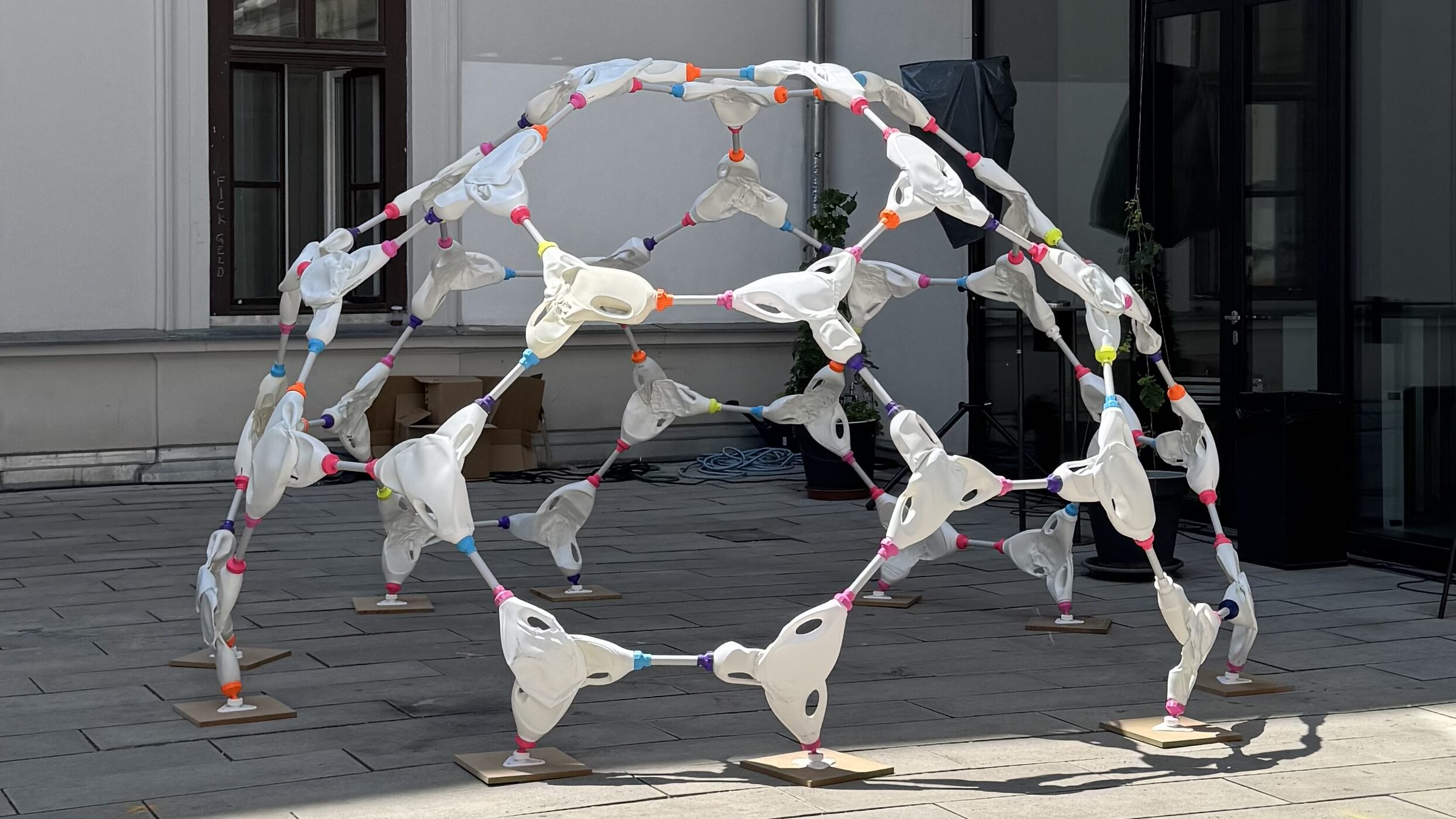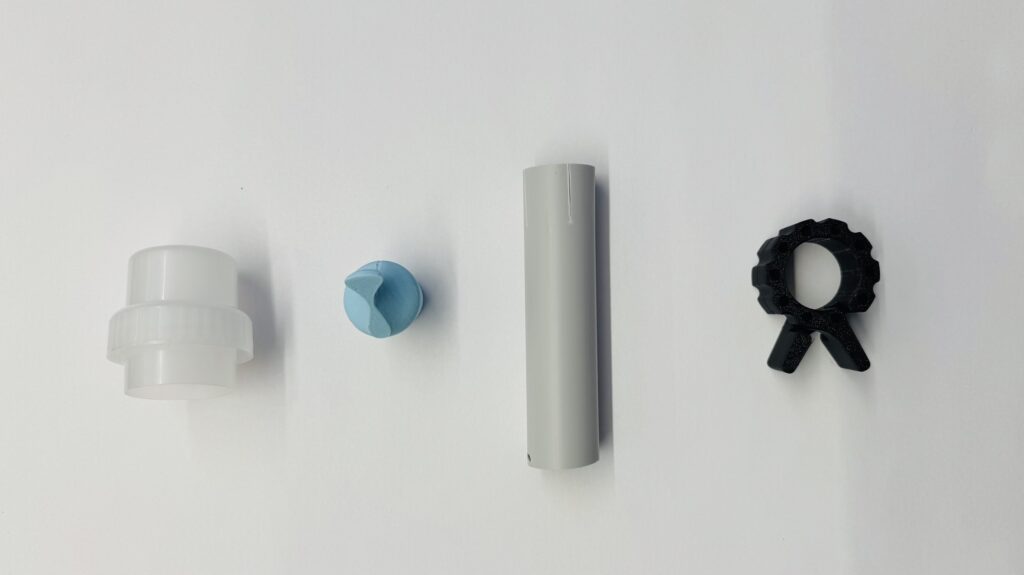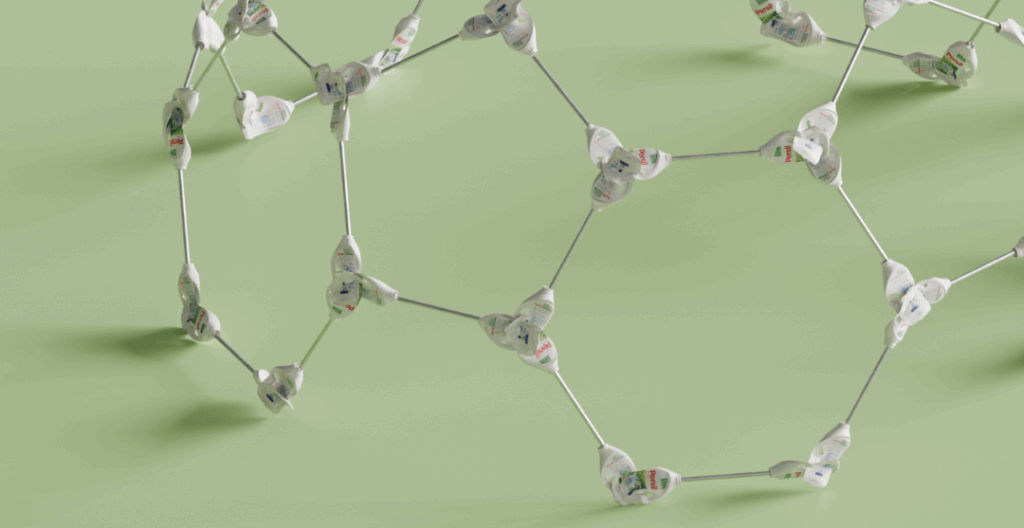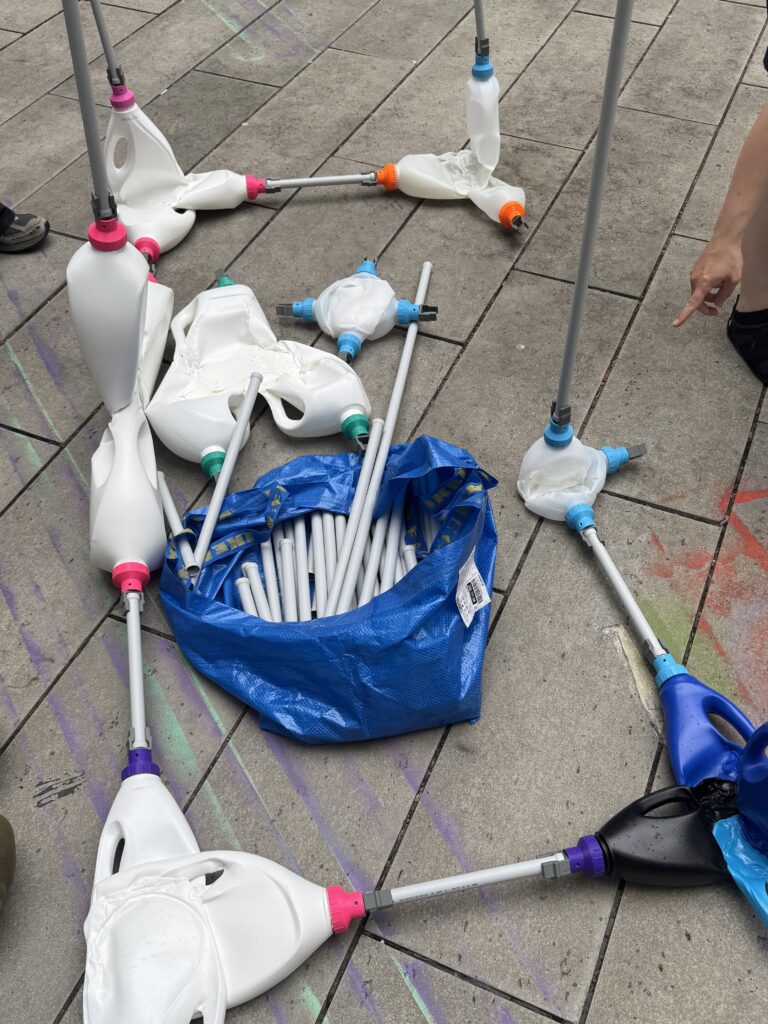
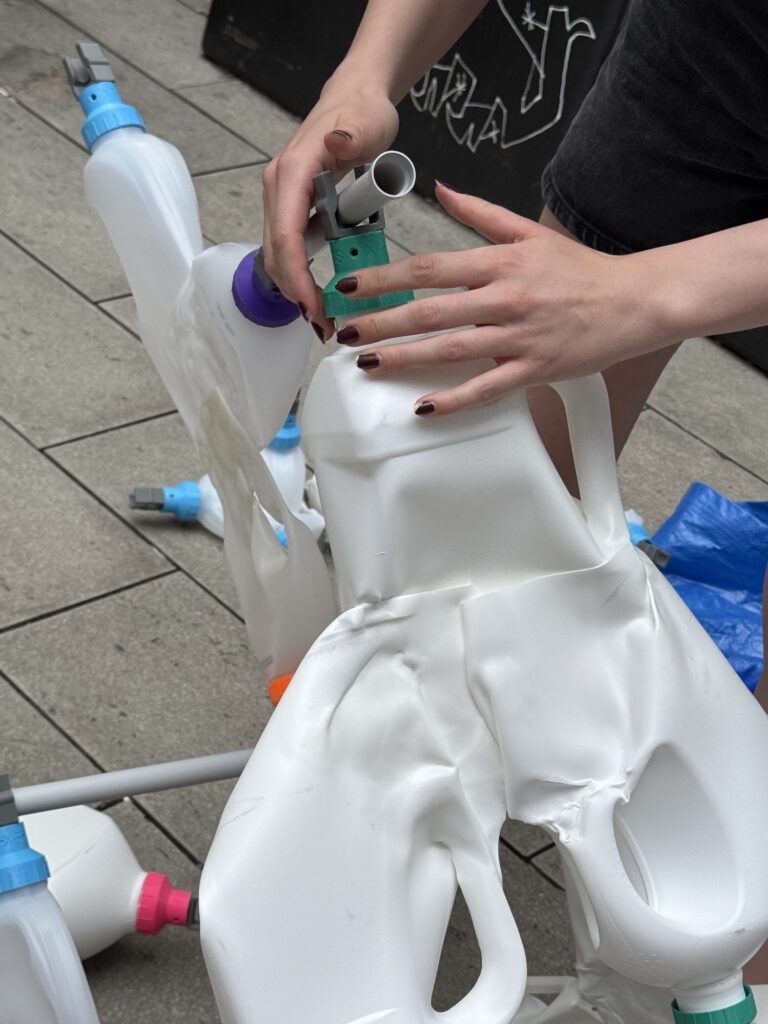
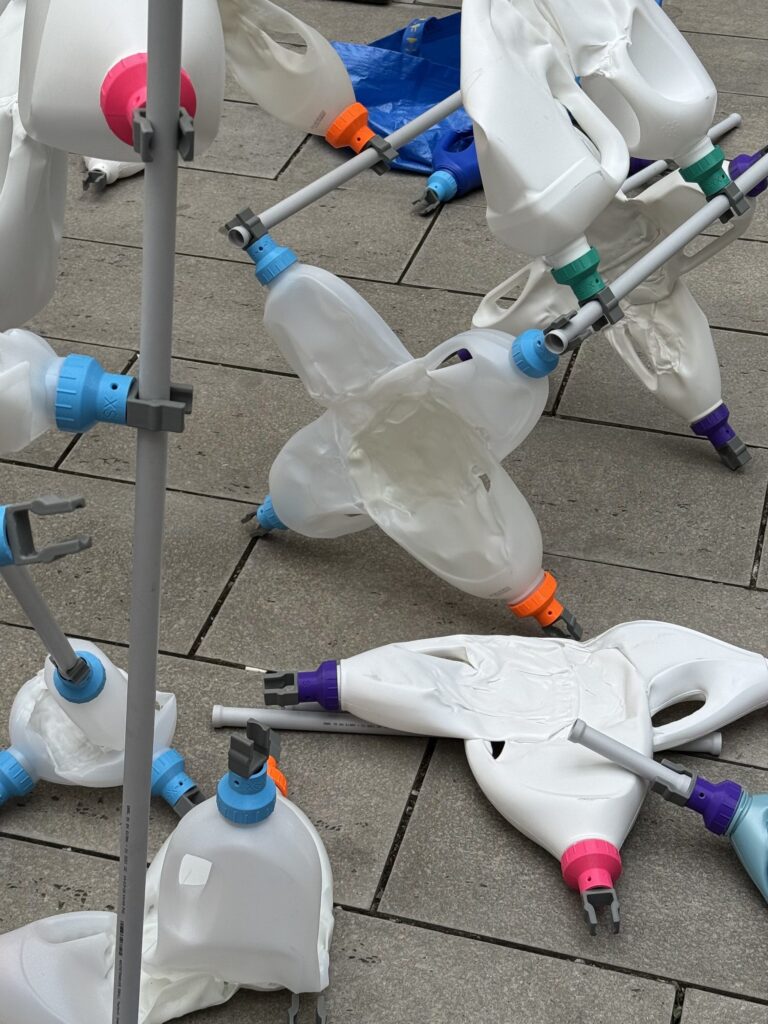
We constructed a quarter dome using detergent bottle Flex Nodes and PVC pipe connections. The prototype consisted of 20 nodes (60 bottles), 25 PVC pipes, and 50 3D-printed ABS connectors.
Continue reading
We constructed a quarter dome using detergent bottle Flex Nodes and PVC pipe connections. The prototype consisted of 20 nodes (60 bottles), 25 PVC pipes, and 50 3D-printed ABS connectors.
Continue reading
Following the insights from our tension tests, we shifted our focus towards redesigning the bottle cap as a connection element. The aim is to develop a 3D-printable cap that allows pipes to be inserted and fixed, enabling the construction of stable systems.
Continue reading
Before proceeding with the construction of a detergent flex-node system, we conducted a series of physical experiments to evaluate which parameters perform best under tensile forces. The goal was to identify the most effective combination of cone geometry and pipe cut configuration.
Continue reading
In this study, we explore how to create a simple connection system between the detergent-bottle nodes and PVC pipes. The aim is to develop a connector system that:

We’re returning to the detergent bottle — and to the techniques we explored earlier with pressed plastic panels in the Pearse structure. But this time, the goal is to preserve more of the bottle’s original shape while still transforming it into a structural element.
Continue reading
In this phase of the project, we’ve shifted our perspective. Until now, the physical experiments revolved around pressing artefacts into a predefined geometric mold. Specifically, we worked with the Peter Pearce’s Curved Space System, using saddle pentagons to form a continuous surface. This approach treated geometry as the fixed system, and artefacts as materials to be adapted. But what if we turned the concept around?
Continue reading
Recycling plastic into panels for Peter Pearce’s Curved Space structure presents several challenges, from understanding material properties to refining the molding process. Through this series of experiments, we explored different plastic types, tested different melting techniques to create saddle pentagon panels.
Continue reading
We’ve recreated all five pieces of the Curved Space for 3D printing, transforming them into a toy. The goal was to explore the challenges and problems of the structure on a small scale in order to better understand what needs attention when scaling up.
Continue reading
For Cluster 3, the goal is to explore thermoplastics, a category of plastics which is suited for projects involving deformation, bending, and reshaping— could be perfect for creating a structure inspired by the principles of Peter Pearce’s “Curved Space Diamond Structure”.
Continue readingIn an effort to advance discrete element aggregation using the Grasshopper3D plugin WASP (and Andrea building new features into it along the way), we are exploring a ‘sequence-based design’ approach and identified Peter Pearce’s Curved Space Diamond Structure as an ideal foundation.