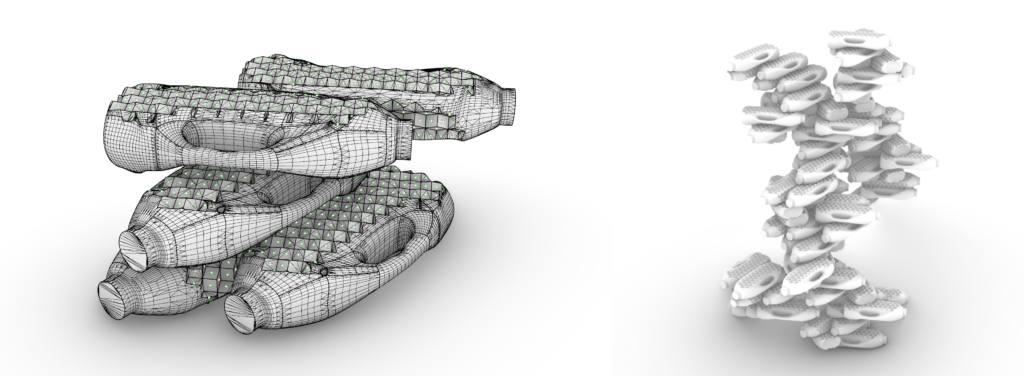
In order to simplify rules definition for Wasp Parts with a high number of connections, we implemented a new method which allows to manually aggregate Parts in Rhino, and automatically detect rules from this manual Aggregation structure.
Applying a clustering algorithm to an inventory of irregular unique objects can help to reduce the complexity involved in designing with such parts significantly. By dividing the inventory items into groups with similar characteristics, each group can then be represented by one “proto-part” instead, therefore reducing the amount of unique elements to be handled in setting up aggregation logics and the aggregation processes. The decision about the number of different groups (Fig. 1) can be completely left to an algorithm (depending on various predefined – by the programmer – conditions) or be manually determined by the user/designer.
Fig. 1: clustering of inventory with different amounts of groups (“proto-parts”)