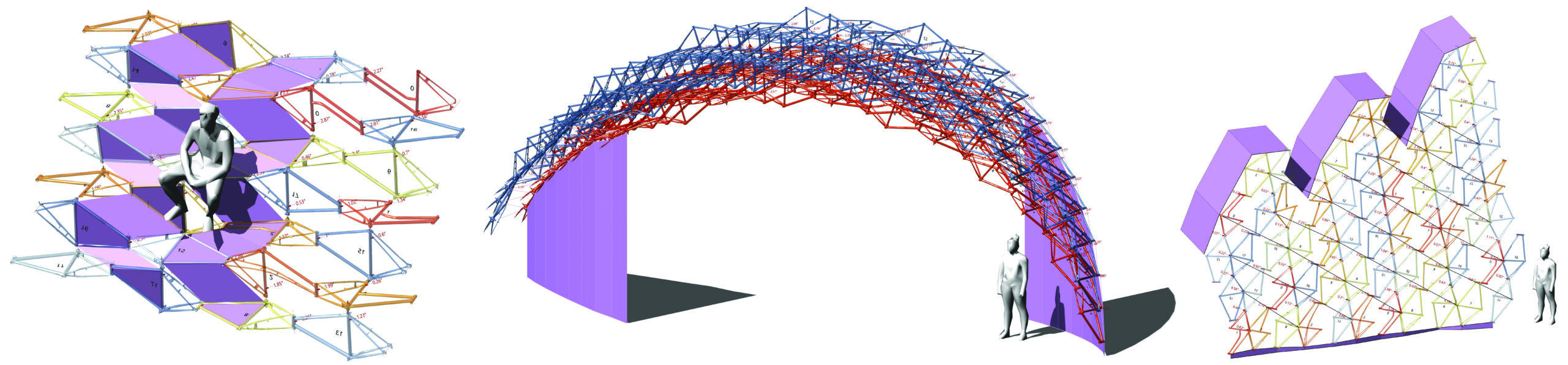
Based on the specific potentials, we sketched potential use case scenarios for three different patterns.
This study was also part of our paper that we presented at the ICSA 2025 conference in Antwerpen earlier this year.
We translated the findings from previous studies on adaptability, and deformation stiffness, to the design of possible architectural schemes. Each case is derived from the specific properties of each pattern, each resulting in a different scale.
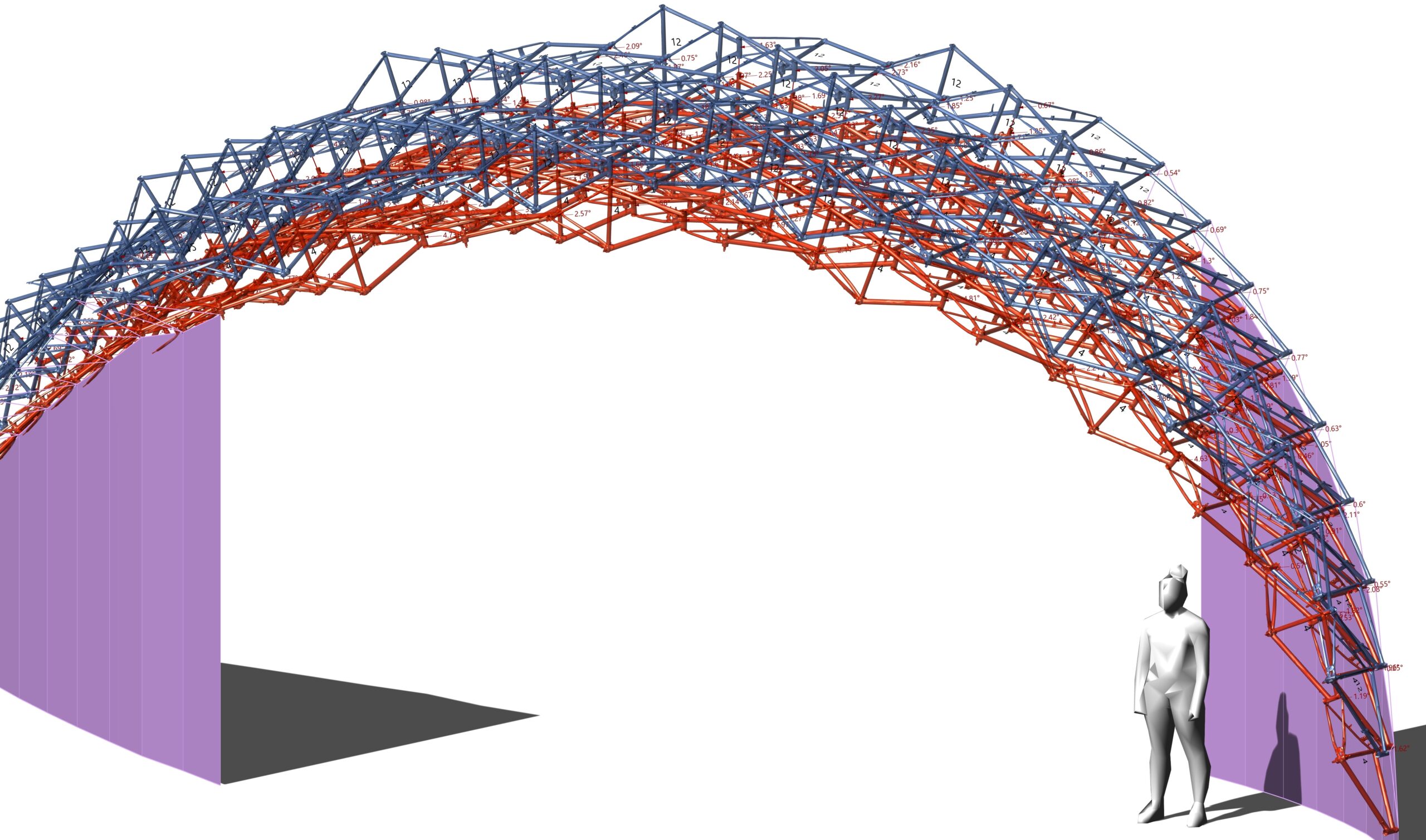
Pattern 1 allows for some global deformation. The threshold for bending is small, but when considering a large grid shell made of bike-frames, a slight curvature of the structure can be introduced to form a vaulted roof. Like in an initial study on a two-layered lattice-shell, the global form is a result of positioning smaller frames (red) at the bottom, and larger frames (blue) at the top layer. Dependent on the size differences, the curvature emerges naturally in the connection-alignment simulation.
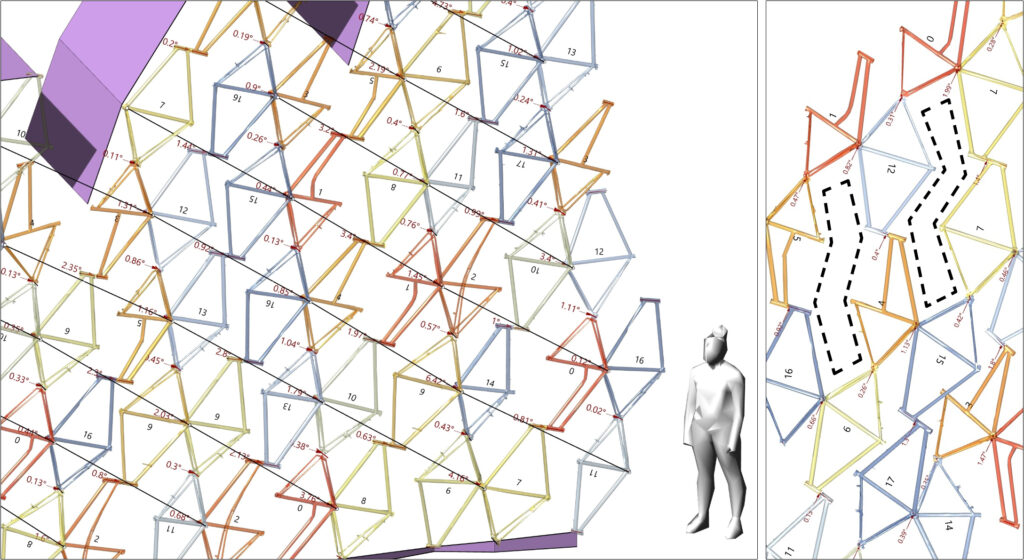
Pattern 2 has a higher resistance towards bending, but due to its flexible pattern structure with 6 parts constituting a cell, and 4 parallel hinges it can adapt well to part variation, but only within the principal aggregation plane. When positioning an assembly vertically, a structure similar to a curtain-wall facade could be possible. To stabilize the system, additional elements for bracing, such as tension cables would be necessary. The system’s flexibility could also allow for local modifications, to produce larger openings (right).
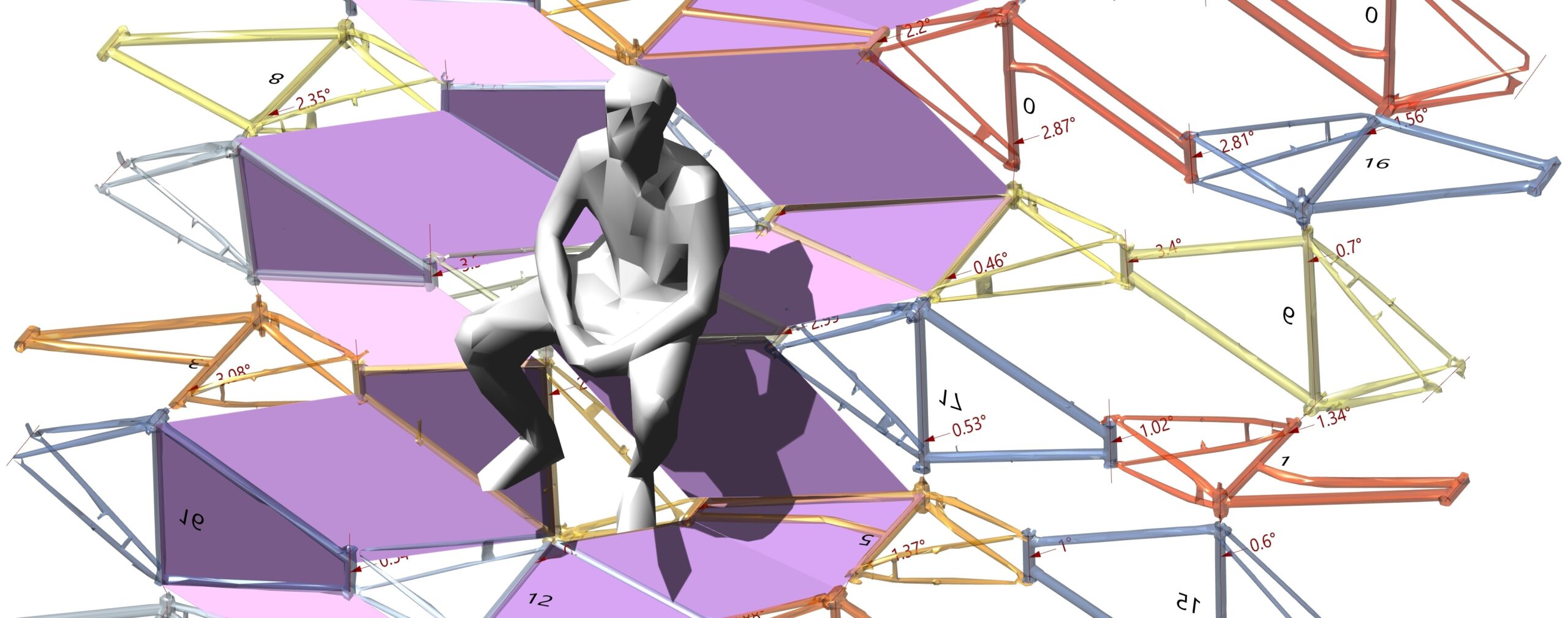
The folded zig-zag structure of pattern 3 is the most rigid and stable. In part this is also due to the smallest cell size, containing only 4 parts which on the other hand makes this pattern the least adaptive to part variations. When a constellation of parts is found with its connections aligned within acceptable threshold, the aggregation could serve as a self-supporting structure eg. providing a seating step function when combined with panels as complementary parts.